How Kaertala works: the two-action daily system
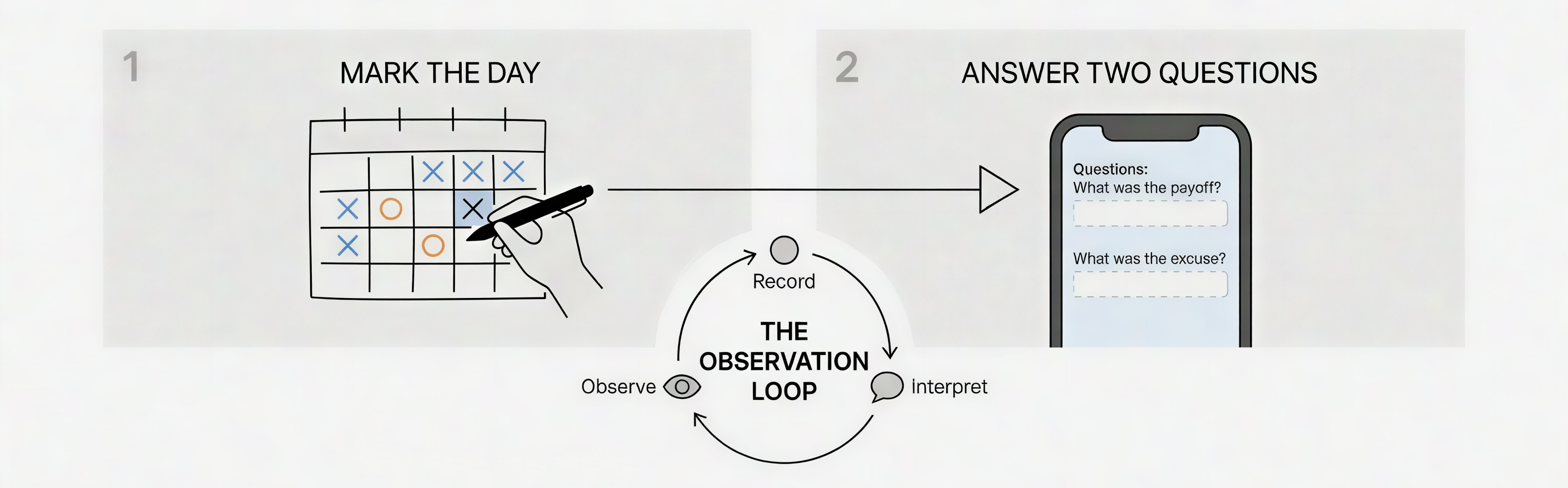
Kaertala is intentionally small. At the daily level, it asks for two simple actions:
- Mark the day on the calendar
- Answer two journal questions
That is the whole platform. On creation the purpose was not to build a complex recovery ritual. The purpose is to create a repeated loop of observation and devaluation: observe the behavior clearly enough to stop romanticizing it, and devalue the promise enough that it stops looking necessary. We are trying to get out of the reader's way as much as possible.
The scientific premise
The app is built around a narrow claim: addictive behavior is often maintained not just by habit or impulse, but by the belief that the behavior still does something important to solve the deeply painful problem which causes the addiction. Sometimes that looks like relief. Sometimes it looks like control. Sometimes it looks like identity, shame, or self-meaning.
Researchers have long argued that addictive behavior persists partly because it seems to offer relief [1]. Relapse-prevention models add that context matters too: what the person expected to get, how they responded, and what meaning they gave the lapse [2].
Kaertala does not try to solve that problem by asking the user to perform a large number of daily tasks. It tries to solve it by tightening attention around the exact argument that is still protecting the behavior.
Why only two daily actions
Behavior-change research repeatedly finds that self-regulation mechanisms matter. Across meta-analytic literatures, self-monitoring and related self-regulatory techniques show up as central components of health behavior change interventions [3].
That does not mean more tracking is always better. Excessive tracking can become its own form of avoidance, performance theater, or compensation. Kaertala therefore reduces the daily job to the smallest loop that still does useful work:
- record the day
- interpret the day
The calendar handles the recording. The journal handles the interpretation.
Action One: mark the day
The calendar is the simplest layer in the system. Its job is not deep insight. Its job is signal capture. In the current app, you can mark a day with a symbol, a color, or both. The important distinction is structural:
- a mark means the day was seen, not ignored
- an
xis treated as a breach - other marks are context, not automatic failure
- color is there to help the user preserve nuance, not to drive the algorithm by itself
If the user waits until much later to think about the day, memory starts editing what happened. The breach gets softened, the trigger gets blurred, and the bargain behind the behavior gets harder to see. Marking the day close to when it happened preserves a cleaner record. That is the same basic reason ecological momentary assessment became useful in substance-use research: it captures experience closer to the event, before memory reshapes it [4].
Kaertala is not doing full EMA in the research sense. It is using a lighter version of the same principle: do not trust memory alone when the thing being studied is episodic, emotional, and easy to rationalize after the fact.
Action Two: answer two questions
The journal is the interpretive layer. Kaertala does not treat journaling as generic emotional venting. The questions are short on purpose. They are meant to catch the excuse or story that is protecting the behavior today, not send the user into pages of unfocused reflection.
The current app follows a simple sequence: the assessment gives the journal a starting pattern, and the daily questions use that pattern together with the user's recent use of the app to decide where to put pressure that day.
The first question is the bridge question. It connects the user's starting pattern to the current day. The second question is the pressure question. It tries to expose the active permission, loophole, payoff, verdict, or post-slip story.
This design is heavily informed by cognitive-behavioral thinking. CBT has real evidence behind it in alcohol and drug treatment, but researchers still debate what exactly produces the change [5] [6]. Kaertala takes a practical position: keep the daily questions tied to the user's current pattern, and keep using them to expose the excuse protecting the behavior until that excuse loses force.
The three starting patterns
Kaertala's assessment is not a formal diagnosis. It is a sorting device. In the current app, it tries to identify which of these patterns is most active:
Relief
This is the pattern in which the behavior still appears to provide relief, anesthesia, quiet, reward, or escape.
The point is not simply that the user likes the behavior. The point is that the behavior still seems to do a job for them: calm them down, numb something, or help them get through a difficult state. That fits negative-reinforcement models of addiction, which treat relief from distress as a major reason people keep returning to the behavior [1].
Management
This is the pattern in which the user is not fully defending the behavior in the abstract, but is still trying to manage it, negotiate with it, or keep it available under better rules.
This is where Kaertala borrows from work on ambivalence. Motivational interviewing treats mixed motives as a central part of change, not a minor complication [7]. In Kaertala's terms, the management pattern means the user says they want out, but is still leaving rules, conditions, or exceptions under which the behavior can stay available.
Identity
This is the pattern in which the behavior has fused with self-meaning: weakness, damage, defectiveness, or "this says something final about me."
Shame matters here, but not in a simple way. Research suggests it is tied more clearly to substance-use-related problems than to substance use in every setting across the board, and it can matter more strongly in some contexts than others [8]. Kaertala therefore treats shame and identity stories as things worth examining, not as the single explanation for every case.
How the Question Algorithm Works
The journal system is not random. At a high level, the algorithm uses the user's earlier pattern together with their recent use of the app to decide what today's questions should target. The two questions have different jobs. The first connects the day's situation to the user's established pattern. The second pushes more directly on the excuse, bargain, or interpretation that is keeping the behavior alive.
This is why the questions are intentionally narrow. Broad prompts often produce broad answers. Kaertala is trying to elicit useful specificity:
- What was the payoff?
- What was the excuse?
- What was the loophole?
- What did the lapse come to mean?
That also fits relapse-prevention thinking. In that view, what matters is not only that a lapse happened, but what the person decides the lapse means afterward [2].
Why the system uses a calendar and not only a journal
If the journal were the only tool, the user could write a lot without clearly seeing what actually happened. If the calendar were the only tool, the user could track the behavior without confronting the reason it still makes sense to them. Kaertala uses both because they solve different problems:
- the calendar captures behavior
- the journal interrogates meaning
That is the philosophy of the two-action system. Kaertala does not assume that insight by itself is enough. The narrower claim is that repeated observation can make the behavior easier to see clearly, and repeated questioning can make its promised payoff look less convincing over time.
What Kaertala is trying to do
Kaertala is not trying to help the user become a better addiction manager. It is trying to make management less necessary by changing what the behavior appears to be worth.
Kaertala is not mainly trying to reduce the strength of the urge in the moment. It is trying to weaken the argument that makes the urge sound reasonable in the first place:
- this will calm me down
- this time is different
- I can handle it if I set better rules
- I already failed, so it no longer matters
- this says I am broken anyway
The app is designed to go after those interpretations directly.
What Kaertala can honestly claim
Scientific honesty matters here, but so does clarity. Kaertala is built from serious source literatures: self-monitoring, ecological assessment, CBT, ambivalence, relapse prevention, and shame research. It takes those ideas and turns them into a focused daily system.
The clearest claim is this:
Kaertala is an evidence-informed daily system designed to help the user see the behavior more clearly, understand what still protects it, and make it lose value over time.
That is not a small claim. It is the core promise of the app.
The short version
If you want the entire philosophy in one sentence, it is this:
Kaertala is a two-action daily system that asks you to mark the day and answer two questions so the behavior becomes harder to romanticize and easier to refuse.
References
- Baker TB, Piper ME, McCarthy DE, Majeskie MR, Fiore MC. Addiction motivation reformulated: an affective processing model of negative reinforcement. Psychological Review. 2004;111(1):33-51. DOI: 10.1037/0033-295X.111.1.33
- Marlatt GA. Taxonomy of high-risk situations for alcohol relapse: evolution and development of a cognitive-behavioral model. Addiction. 1996;91 Suppl:S37-S49. PubMed: 8997780
- Hennessy EA, Johnson BT, Acabchuk RL, McCloskey K, Stewart-James J. Self-regulation mechanisms in health behavior change: a systematic meta-review of meta-analyses, 2006-2017. Health Psychology Review. 2020;14(1):6-42. PubMed: 31662031
- Shiffman S. Ecological momentary assessment (EMA) in studies of substance use. Psychological Assessment. 2009;21(4):486-497. PubMed: 19947783
- Magill M, Ray LA. Cognitive-behavioral treatment with adult alcohol and illicit drug users: a meta-analysis of randomized controlled trials. Journal of Studies on Alcohol and Drugs. 2009;70(4):516-527. PubMed: 19515291
- Magill M, Tonigan JS, Kiluk B, Ray L, Walthers J, Carroll K. The search for mechanisms of cognitive behavioral therapy for alcohol or other drug use disorders: a systematic review. Behaviour Research and Therapy. 2020;131:103648. PubMed: 32474226
- Miller WR. Motivational interviewing: research, practice, and puzzles. Addictive Behaviors. 1996;21(6):835-842. PubMed: 8904947
- Luoma JB, Chwyl C, Kaplan J. Substance use and shame: a systematic and meta-analytic review. Clinical Psychology Review. 2019;70:1-12. PubMed: 30856404